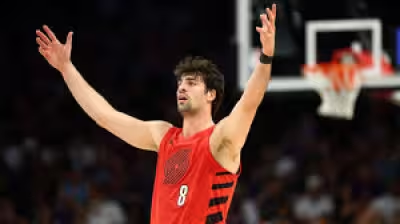
Netflix debuted “Untold: Jail Blazers” on Tuesday, turning back to the Portland Trail Blazers team that became known for what it did off the court as much as on it. The documentary centers on Rasheed Wallace, Damon Stoudamire, Bonzi Wells and former general manager Bob Whitsitt, and it revisits a roster that was talented enough to chase a title but chaotic enough to earn a nickname that stuck.
That nickname was never built on one moment. It came from a string of them: Wallace and Stoudamire riding in a car that was stopped for speeding after a December 2001 game in Seattle and later cited for marijuana possession; Stoudamire getting arrested again on marijuana charges in 2003 and then being suspended by the Blazers; and Shawn Kemp, acquired by Portland in 2000, checking into drug rehab during the 2000-01 season because of cocaine use. Wallace also set the NBA single-season record with 41 technical fouls in that same season, a number that still hangs over his name years later.
The Blazers were also carrying other baggage. Portland lost 10 of its final 13 games in the 2000-01 season, and Ruben Patterson had to register as a sex offender in 2001 after being charged with attempted rape. Wells said he also had to answer to an article suggesting that he hated Portland fans. Stoudamire, who had won Rookie of the Year in 1995-96 with Toronto before being traded to the Blazers in February 1998, said he, Wallace and other players did a lot of positive work in the community, and that the “Jail Blazers” label overshadowed much of it.
That is the tension at the heart of the documentary and the era itself. The team’s off-court incidents alienated fans and hardened a name that was meant as a taunt, even as people inside the locker room say the picture was never that simple. Whitsitt’s explanation for why he kept adding players with difficult backgrounds, and why the team was eventually broken up, gives the film its sharpest edge: Portland was not just a talented team with bad optics. It was a group whose promise and problems became impossible to separate.
Wells said that in the moment, the group wore the reputation like a badge of honor, comparing the era to the Bad Boys of Detroit and the Showtime Lakers. Years later, he said, that feeling changed. Stoudamire put it another way, saying he looked at it a little differently, a small admission that lands harder now than it would have in the middle of the mayhem. Twenty-six years later, the documentary asks viewers to decide whether Portland was remembered for its basketball or for the noise around it — and the answer, for many fans, has already been made.