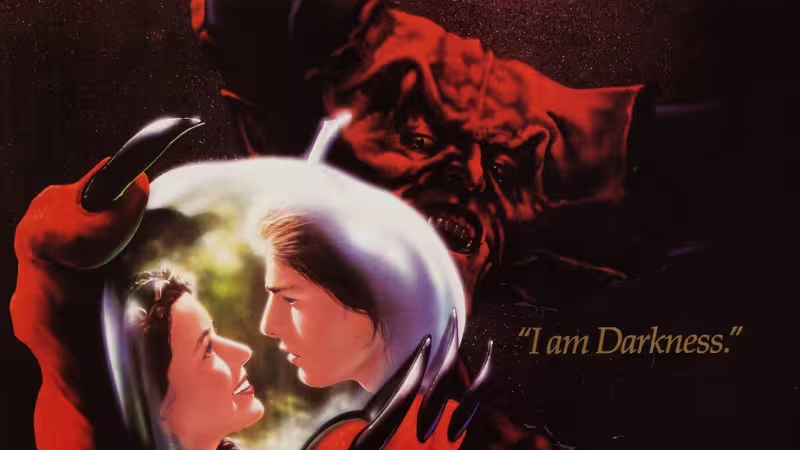
When Legend premiered in the United States on April 18, 1986, Tim Curry had already given the film its most unforgettable figure: the Lord of Darkness. Four decades later, the movie is being revisited for its 40th anniversary, and Curry’s performance still sits at the center of the discussion.
Directed by Ridley Scott and written by William Hjortsberg, Legend opened in a blaze of ambition that matched its reported $25 million budget. Curry later told Rolling Stone that his role was “another color in a Ridley Scott painting,” a line that fits a movie built to overwhelm the eye as much as the story. It was first shown in August 1985 at the Venice Film Festival before reaching U.S. theaters the next spring.
The numbers told a harder story. Legend took in about $23.5 million worldwide, leaving it below its budget and short of the kind of commercial run that would have matched its scale. But the film’s life did not end there. In 2002, a restored director’s cut helped give Legend a second life and eventually a cult following, the kind that tends to grow around movies that fail in the marketplace but linger in memory.

That afterlife matters because Legend is now remembered less as a box-office disappointment than as one of the most visually ambitious fantasy films of its decade. Its massive soundstage forest sets at Pinewood Studios and prosthetic makeup work led by Rob Bottin helped make Curry’s Darkness one of the era’s most striking screen villains. The movie’s practical craftsmanship, once part of the gamble, is a big reason it keeps drawing attention whenever its anniversary comes around.
Curry, though, was not romantic about the experience. In the same reflection, he made clear he did not see the production as a repeatable template, saying, “I’ll never want to do another picture like that again.” That blunt assessment fits Legend’s place in film history: a spectacular, risky project that earned admiration slowly, then stuck around long after its original release date passed.
The answer to why Legend is still being written about today is simple. It did not become a hit in 1986, but it became something more durable: a film people kept returning to, until the cult following turned its failures into part of its legend.