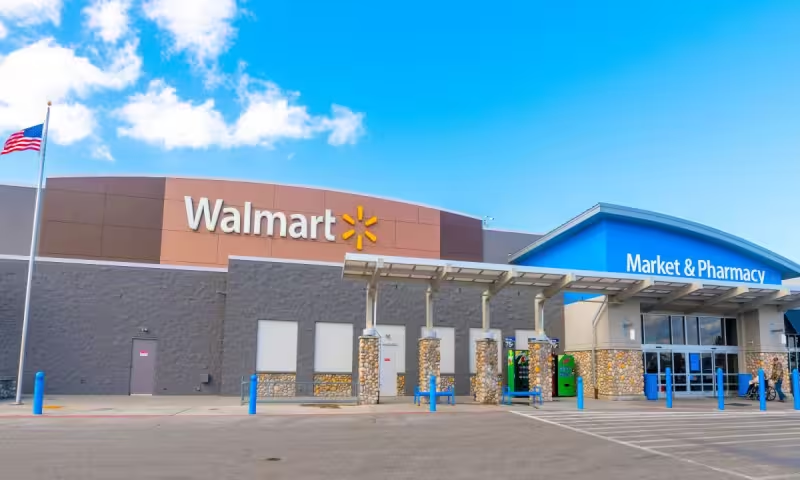
Walmart has begun testing back-room shelves in some stores as a staging area for same-day delivery of third-party merchandise, according to a report Sunday from the Financial Times. The experiments are taking place at several stores in Dallas, a city Walmart has used before to try out new technology.
The move matters because Walmart’s online marketplace remains a small slice of a massive business, even as the company pushes harder into faster delivery. Manish Joneja said the retailer is starting in a few markets and will soon offer a select assortment of marketplace items through the pickup and delivery experience customers already know. He called it an intentional test designed to help Walmart learn and scale over time.
That test also points to a broader shift inside the company. Most of Walmart’s online sales still come from first-party merchandise, while its Supercenter stores typically carry roughly 120,000 individual products. Walmart launched its online marketplace in 2009, and the company has been trying to make that platform more relevant as customers look for more choice without leaving the same checkout flow they already use.
The financial backdrop shows how much room there is to grow. eMarketer data cited by the Financial Times put U.S. sales on Walmart’s marketplace platform at less than $14 billion last year, compared with $483 billion in total net sales. Amazon’s U.S. marketplace sales were $333 billion last year, underscoring the scale of the rival Walmart is trying to meet with quicker third-party delivery.



John David Rainey has said marketplace revenues are growing at around 20% each year, with home, hardlines and fashion rising at more than 30%. He said those are areas where Walmart has been a little weaker on a relative basis, and added that the company has talked about the need to grow its general merchandise assortment. This, he said, is a great opportunity to do that.
Dallas is a logical place for the trial because Walmart has long used it as a test space for new technology. The setup in the back room also suggests the company is trying to use stores it already operates to speed up delivery without depending entirely on separate fulfillment facilities. That puts Walmart stock in the middle of a practical question: how much of the marketplace can be folded into the store network customers already know.
The push comes as Walmart continues to lean on the way shoppers already use it. PYMNTS Intelligence found that 56% of online grocery shoppers under high financial stress made their most recent purchase at Walmart, compared with 50% of low-stress online grocery shoppers. In stores, the share was 37% for high-stress shoppers and 26% for low-stress shoppers. The numbers suggest Walmart’s reach is already deep, but the marketplace test shows the company wants that reach to cover more of the basket, not just groceries and its own goods.
For now, the important detail is not that Walmart has a new idea. It is that the company is trying to attach that idea to the store system it already runs at enormous scale. If the Dallas test works, Walmart could make third-party delivery feel less like an add-on and more like part of the core shopping experience.