
Apple began as a scrappy start-up that assembled computers by hand, and 50 years later it has become one of the clearest examples of how to build a global technology company. That arc was the focus of a New York Times article by Kalley Huang published on April 2, which traced how the company’s earliest experiments grew into a model others tried to copy.
The company’s name suited a Valley still surrounded by orchards, before office parks took over the landscape. But the reach of Apple’s early work went far beyond its own balance sheet. Steve Wozniak said in a 2014 interview that he had “given away my designs for the Apple-1 for free,” while Steve Jobs took projects Wozniak had “designed for fun” and found a way to “somehow turn them into some money for both of us.”
That pattern runs through the company’s history. Chris Espinosa has worked at Apple since 1976 and says he had “no college degree and … only worked at one company,” a résumé that “doesn’t sound like much of a résumé” even though Huang estimates he holds well over $100 million in Apple stock. The story also points to the wider Apple imprint on the industry: Bill Gates owes much of his fortune to emulating Apple, and products and ideas tied to the company shaped software and hardware far beyond Cupertino.
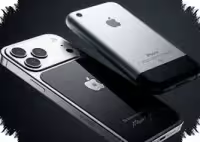

Some of Apple’s most influential ideas were never the biggest money makers. HyperCard made creating and viewing multimedia straightforward. The Pippin brought built-in Internet access to a video game console. The Newton pioneered the personal digital assistant. Halo was first showcased by Jobs at MacWorld before becoming an exclusive killer app for Microsoft’s Xbox, and Windows drew on talent from Macintosh icon designer Susan Kare. Apple’s influence was often measured less by direct profit than by how quickly its ideas escaped the company’s walls.
That tension was visible as early as 1984, when Stephen D. Young and Debra Willrett introduced Backgammon for the Apple Macintosh with a note asking people who enjoyed it and wanted to see more freeware to “please send whatever you think it’s worth.” The software also allowed users to disseminate the program itself. Craig Newmark later put that ethos another way, saying “making money isn’t proof to me that I know something any better than someone else.” Apple’s story, even after 50 years, still turns on that uneasy mix of invention, imitation and value that never stayed inside the company for long.
For Apple, the next chapter is not whether it can still innovate. It is whether a company that began by hand-building machines can keep defining the terms of the industry it helped create.