Federal authorities arrested Special Forces soldier Gannon Ken Van Dyke on Thursday over allegations that he made more than $409,000 by betting on Nicolas Maduro's capture just hours before President Donald Trump announced it. Prosecutors say Van Dyke wagered more than $33,000 on Polymarket and then tried to erase traces of the trades after the money started moving his way.
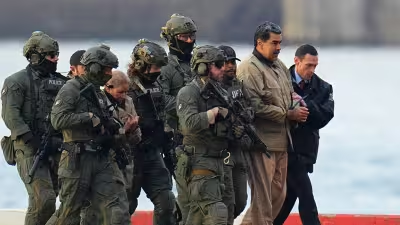
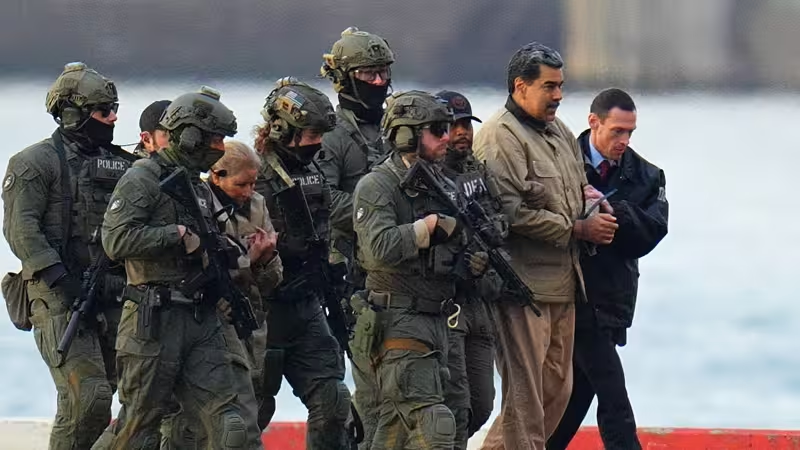
The indictment charges Van Dyke with unlawful use of confidential information for personal gain, theft of nonpublic government information, commodities fraud and wire fraud. It says he placed the bets during Operation Absolute Resolve, including wagers on whether Maduro would be removed from office by Jan. 31 and whether the United States would invade Venezuela.
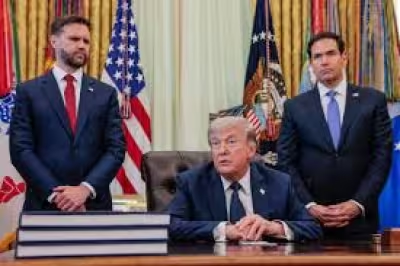
Trump told Americans after the announcement, “We're a respected country again like, maybe, like never before,” and described the people involved in the operation as “highly-trained warriors, operating in collaboration with U.S. law enforcement.” Prosecutors said Van Dyke was photographed on the deck of the USS Iwo Jima wearing military fatigues and holding a rifle alongside other service members, a detail that underscores how close to the operation he may have been.
According to Polymarket, a trader who opened an account in Dec. 2025 bet $33,933 across four predictions tied to the U.S. invasion of Venezuela and Maduro's capture. The largest position was a $32,537 bet that Maduro would be out of office by Jan. 31, and it returned a 1,242% profit of $404,222. Polymarket said it referred the suspicious trades to the Justice Department and cooperated with the investigation, while a spokesperson said, “Insider trading has no place on Polymarket. Today's arrest is proof the system works.”
The arrest and indictment appear to be the first time the Justice Department has brought an insider-trading case tied to a prediction market, a fast-growing corner of finance that lets traders anonymously buy yes-or-no contracts on future events. The indictment says Van Dyke was involved in Maduro's capture, but it does not explain his role in the raid, leaving the central question now not whether the market moved, but how much inside information reached a trader before it did.