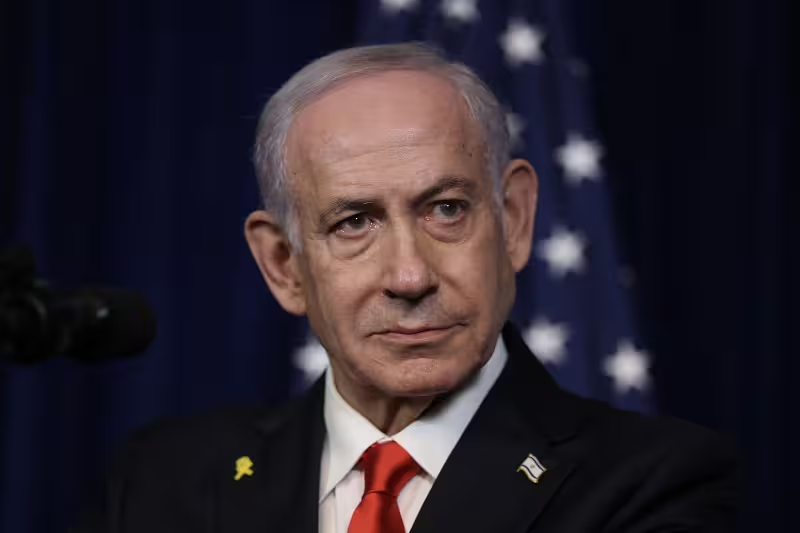
Benjamin Netanyahu has spent almost all of the last 16 years in power, but the next election may be the one that finally ends that run. Polls consistently show that if Israelis voted now, his governing coalition would lose its majority, even as the country is required to hold elections no later than October.
The pressure is not only political. Netanyahu is on trial for corruption, with the most serious charges tied to a scheme to trade regulatory favors for favorable coverage from a major Israeli outlet. At the same time, President Donald Trump is pressing Israeli President Isaac Herzog to grant him a pardon, adding a new layer of urgency to a fight already shaping the country’s next chapter.
The stakes reach beyond one man. Netanyahu has been prime minister since 2009 for all but one year, and his government has put allies in charge of security services, demonized the Arab minority, persecuted left-wing activists and pushed legislation that would bring the judiciary under his control. Those moves have made him the central figure in a battle over whether Israel’s democratic system can still restrain its leaders.

That battle is being watched through an outside lens as much as a domestic one. Earlier this year, Yonatan Levi traveled from Israel to observe the Hungarian election with parliamentarians and activists, studying how opposition leader Péter Magyar was mounting a winning campaign against an authoritarian prime minister. Levi said Israel “is not the Middle East’s Hungary yet,” but added that “it’s getting closer and closer,” a warning that captures the concern among critics of Netanyahu’s tactics, which they see as lifted from Viktor Orbán’s playbook for holding power.
Levi also said, “I’ve never seen a foreign election being covered so closely [in the Israeli press] — except for US elections,” a sign of how deeply the Netanyahu fight has penetrated public life. Israelis, Jewish and Arab alike, still participate in political life that is meaningfully democratic, and elections are generally free of fraud, with opposition parties competing openly under relatively fair conditions. But that picture changes in the West Bank, where Palestinians live under Israeli military occupation and cannot vote in Israeli elections, and it looks even grimmer in Gaza. That broader reality is part of why the coming vote is being treated not just as another contest for office, but as a test of whether Israel’s democratic institutions can withstand a prime minister who has spent years trying to bend them to his will.
For Netanyahu, the immediate question is whether he can survive long enough to fight the election on his own terms, or whether the combination of legal jeopardy, public fatigue and Trump’s pardon push will narrow his room to maneuver before Israelis go to the polls.