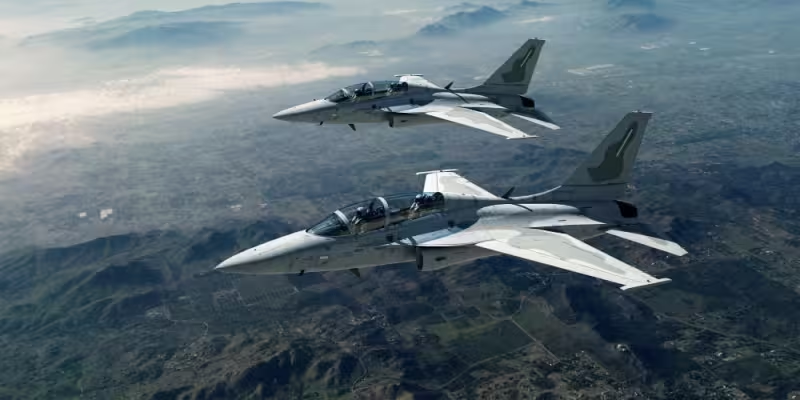
The Navy has opened the final round of its search for a new jet trainer to replace the T-45 Goshawk, issuing a Final Request For Proposals for the Undergraduate Jet Training System and seeking 216 modern aircraft for the next generation of naval aviators. The move pushes a long-running program into its decisive phase and narrows the field for a contract that will shape how the service teaches pilots to fly from the first days of advanced training.
One of the most closely watched bids comes from SNC, which is leading Team Freedom, the only group in the competition with a clean-sheet design. The Freedom Trainer is being pitched as a jet built specifically for the Navy’s changing carrierborne training needs, with SNC saying it can deliver modern capability at much lower lifecycle cost. Team Freedom includes Northrop Grumman, General Atomics Aeronautical Systems, Inc. and CAE.
Jon Piatt said Team Freedom combines speed and experience in a way the Navy can use now. “SNC’s Team Freedom brings the agility of a disruptor and the reliability of our well-established defense partners to bear so that we can deliver what the Navy wants, on the aggressive timeline it set,” Piatt said.


The competition has been reshaped by a series of training changes that make it different from the program that first set out to replace the T-45. The Navy has removed carrier qualifications from the syllabus, and it has also dropped the requirement for Field Carrier Landing Practice to touchdown, now asking only for FCLP to wave off. In August 2025, a Navy spokesperson told TWZ that FCLP landings ashore are still required for graduation.
That shift matters because several off-the-shelf trainers can handle the reduced requirement. The T-7 Red Hawk, the Korean-built TF-50N and the Italian M-346N can all perform FCLP to wave off, but they cannot make repeated unflared touchdowns without extensive structural reinforcement. Taking touchdown landings out of the formal requirement broadens the field and makes it easier for the Navy to compare new-build concepts with existing aircraft already flying or in production.
Derek Hess said that change comes at a cost to the training pipeline. “FCLP-to-touchdown is a tried and trusted method to train naval aviators,” Hess said. “Not performing carrier qualification or FCLPs-to-touchdown essentially defers that training to the fleet replacement squadrons with their 4th-, 5th”
The Navy’s decision reflects how much undergraduate jet training has changed since the T-45 entered service. Advances in automated carrier landing systems and simulation have altered the way officials think about what student aviators need before they reach the fleet, and the removal of carrier qualifications from the T-45 syllabus came before this final proposal stage. Even so, the latest rules leave one central question answered in practice: the service is buying a trainer for a different kind of Navy, and the aircraft that wins will need to fit that new model, not the old one.