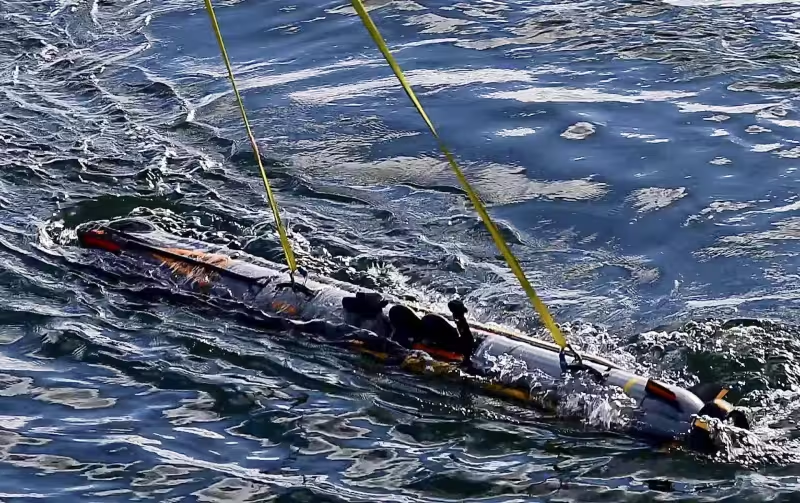
Darpa opened a new push on Thursday for deep-ocean drones that it says should be smaller, faster to build and cheaper than the full-ocean-depth autonomous vehicles used today. The solicitation, for a program called Deep Thoughts, seeks compact autonomous craft that can reach the deepest parts of the ocean at a fraction of the size of current state-of-the-art systems.
The agency said the program will use advances in materials, manufacturing and next-generation structural and mechanical design to cut size, cost and development time. In Darpa's words, the effort is intended to provide responsive and scalable access to the deep ocean, where the agency says access itself offers a significant strategic advantage.
The program's pitch goes well beyond conventional underwater engineering. Darpa said it wants vehicles that do not depend on architecturally constraining components, can deploy from a wide range of host platforms and may be designed, produced, tested and integrated in months or even weeks instead of the years that such work usually takes. It is also looking for novel materials, alloys and structural geometries, along with firms willing to take a non-traditional approach to subsystem and component architecture.


That matters because deep-ocean exploration is slow, difficult and expensive, in large part because of the crushing pressure found at full-ocean depths. Deep Thoughts frames the problem less as a science exercise than as another autonomous systems race, one aimed at giving the military and industry more flexible reach into places that have traditionally demanded large, costly platforms.
Darpa also wants a multi-level secure digital engineering environment that supports CI/CD/CP workflows, protects intellectual property and works across multiple classification levels during development. That requirement suggests the agency is trying to compress the path from concept to fielding without giving up control over highly sensitive design work, a tension that often slows programs exactly like the one it is now trying to accelerate.
The result is a program built around speed and scale, not just depth. If Darpa gets the kind of responses it wants, Deep Thoughts could produce a new class of compact underwater vehicles that are easier to build, easier to move and harder to ignore once they reach the deep ocean.