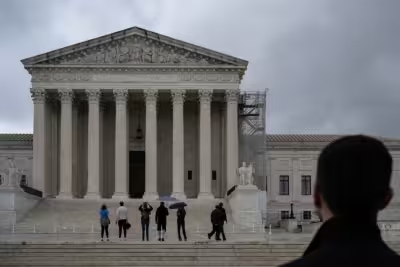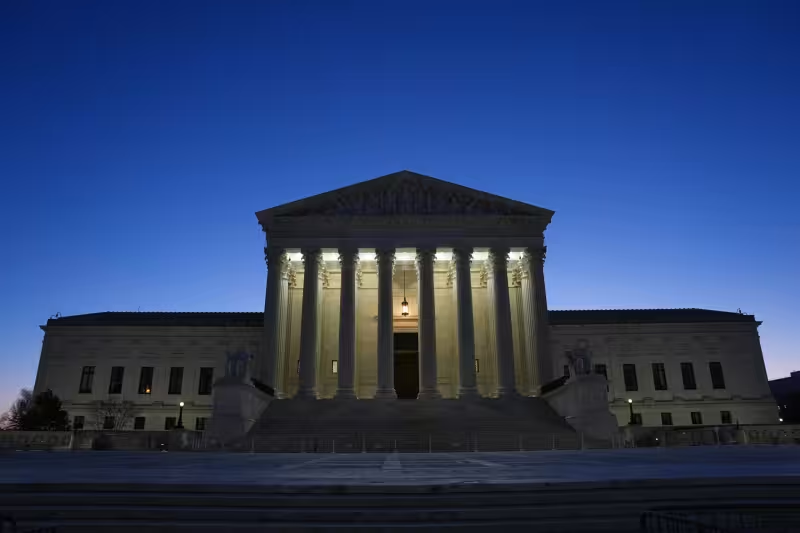
The Supreme Court on Monday cleared Texas to use a new congressional map in the 2026 midterms, issuing a summary reversal that wiped out a lower-court ruling blocking the state's mid-decade redistricting. The court's order came with no additional explanation.
The decision lets Texas move ahead with a map that could help Republicans pick up five more seats in Congress, a gain that could matter in a closely divided House. Justices Elena Kagan, Sonia Sotomayor and Ketanji Brown Jackson dissented.
Texas began the redraw last summer after President Donald Trump called on Republican-led states to maximize their partisan advantages ahead of the 2026 midterms. Voting rights groups sued, saying the new lines intentionally diluted minority voting power and violated the Voting Rights Act as well as the 14th and 15th Amendments. A panel of federal judges blocked the map in November, and Judge Jeffrey Brown wrote the opinion. Less than a month later, the Supreme Court stayed that ruling while the fight continued.



On Monday, the justices set aside Brown's finding that racial concerns drove the map and instead treated the case as one of partisan gerrymandering. That matters because the Supreme Court has said federal courts cannot block partisan gerrymandering, a line that gave Texas a legal path forward even as the underlying claims remained live. The lawsuit is not over. Other claims in it were filed without seeking an injunction, and those allegations could still affect Texas's congressional map later.
The Texas ruling also landed in the middle of a widening national redistricting fight. California and Virginia have joined the battle in response to Republican gains in Texas, North Carolina and Missouri, while the Virginia Supreme Court heard a challenge Monday to Democrats' redistricting campaign there. In Florida, the legislature began a special session Monday to redraw its map with the goal of flipping four seats to Republicans, a push tied to the broader GOP effort now drawing fresh attention, including in coverage of Florida's special session and related plans by state leaders.
The immediate answer for Texas is clear: the map stands for now, and Republicans are positioned to use it in 2026. The longer fight over whether the lines unlawfully weakened minority voters will continue in court, and the next round of redistricting battles is already moving in other states.