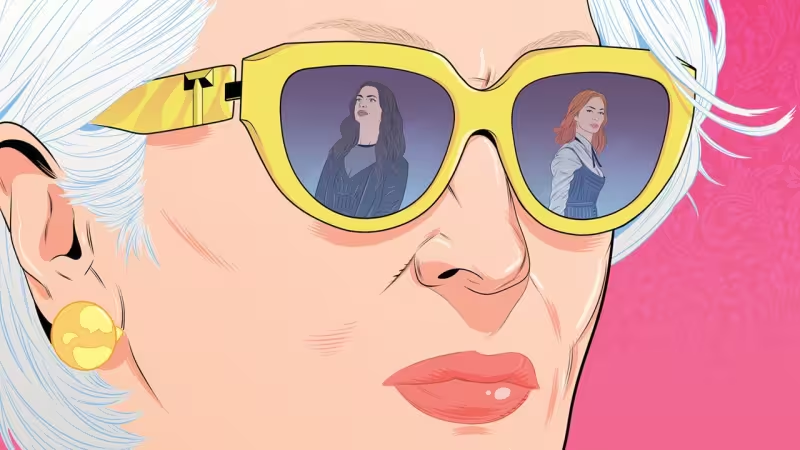
Twenty years after Andy Sachs fluked her way into Runway, Devil Wears Prada 2 brings her back to the glossy office that made her name — only this time she returns after being laid off from an upmarket broadsheet and is offered the job of features editor. The sequel opens with the old machinery of status, snobbery and straight-backed certainty still in place, even if the business around it has changed beyond recognition.
That change is part of the joke and part of the sting. Runway no longer has the colossal budgets it once had, so it has to chase clicks and eyeballs in a fickle digital world, while Miranda Priestly is forced to pay lip-service to body positivity and to rejecting heteronormativity in the workplace. She also has to fly coach, a small humiliation that lands harder because the film knows exactly what she once represented. In the hands of Aline Brosh McKenna, back as screenwriter, and David Frankel, back as director, the sequel keeps the old rhythm but shifts the scenery just enough to show how much the landscape has moved. ’s verdict captures the joke neatly: “a sequel? For spring? Groundbreaking,” before calling it “this glossy knock-off reunites the old team – and recycles the old plot – with style.”
Andy’s path through that world gives the film its momentum. She has a chemistry-free romance with an Australian real estate magnate, dishes with Nigel in the cafeteria, gets fashion guidance from him for a trip to Miranda’s place in the Hamptons, and later heads to Milan. There is also a stretch of backstairs shenanigans in which she works to protect Miranda from a corporate coup, the kind of side-door intrigue the original made look effortless. Emily Charlton is now the head of Dior, and she makes the blunt case that ultra-luxury brands serving the 0.1% are recession-proof, which is exactly the sort of line that sounds absurd until the film reminds you how the business of image has evolved. Simone Ashley also joins the star-packed cast, and Nigel’s return has already drawn attention elsewhere. The result is less a reinvention than a reunion with sharper price tags and smaller margins.
That is why the sequel matters now: not because it discovers a new story, but because it shows how the old one survives in a world ruled by digital desperation and a fashion industry still built around exclusivity. Miranda Priestly, still clearly modeled on Vogue editor Anna Wintour, is no longer the only force in the room; the market itself is. The film’s answer to the question it poses is plain enough. Devil Wears Prada 2 works because it understands that power has not disappeared — it has just become more awkward, more performative and far less willing to pay for the privilege.