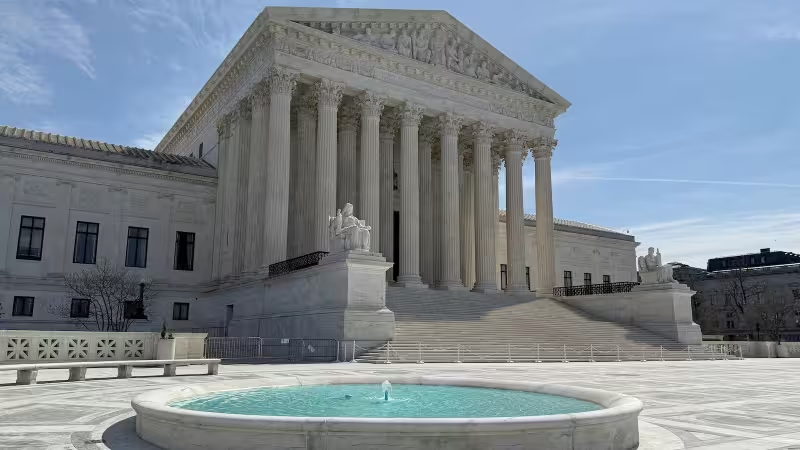
The Supreme Court’s ruling in Louisiana v. Callais could send states back to the redistricting table every few years instead of every 10, and the fight is already moving fast. Louisiana, Alabama, Tennessee and other states are now considering whether to redraw congressional maps before the 2028 elections.
That would mark a sharp break from the once-a-decade rhythm tied to census data. In place of a settled map, the country could be looking at repeated attempts to tilt House districts before voters even reach the next presidential cycle.
Joshua Stockley, a political scientist who has tracked the fight, called it “a domino effect,” and said both parties will keep pushing for as many favored districts as they can until someone says, “Enough is enough.” His warning is now playing out in real time. Louisiana is set to try to redraw its congressional map after Gov. Jeff Landry and state officials announced they would postpone the state’s House primaries, which had been scheduled for May 16.
The move in Louisiana has already been challenged in court, but the stakes go beyond one state. Redrawing the map there could allow Republicans to potentially flip up to two seats, and the ruling could also affect congressional maps and minority representation nationwide. In other words, the decision handed down Wednesday did not just settle a legal dispute; it opened the door to a round of hardball politics that could stretch into the 2028 campaign.

Tennessee may be next. After Trump posted that he had spoken with Gov. Bill Lee, the governor said he would work to redraw the state’s congressional maps. Tennessee’s delegation now includes eight Republicans and one Democrat, a balance that leaves little room for a party looking to squeeze out another advantage.
Alabama is also moving. Secretary of State Wes Allen asked the Supreme Court on Thursday for immediate review of a dispute over the state’s 2023 congressional map, which currently includes a court-ordered additional majority-minority district. On Friday, Gov. Kay Ivey announced a special session of the legislature to start on Monday so lawmakers would be ready to implement previously blocked maps if courts rule in the state’s favor. Alabama is scheduled to hold primaries on May 19.
South Carolina has not yet followed suit, but some legislators there have called on the state to redraw its congressional map in 2026 to box out the state’s one Democratic seat. That is the part of the ruling that is hardest to ignore: the country is already in a mid-decade redistricting cycle, sparked by Trump encouraging Texas Republicans to pass a new congressional map ahead of the 2026 elections. So far, Republicans are favored to pick up 13 districts across five states, while Democrats are favored to pick up 10 across three states, though some of those maps are tied up in lawsuits or expected to face them.
The ruling’s real consequence is not limited to any one election calendar. It gives states a legal opening to redraw sooner, and the parties appear ready to use it. Louisiana, Alabama and Tennessee are testing how far that opening goes, and if courts let them move, the next national map fight may arrive before voters even finish sorting out the last one.