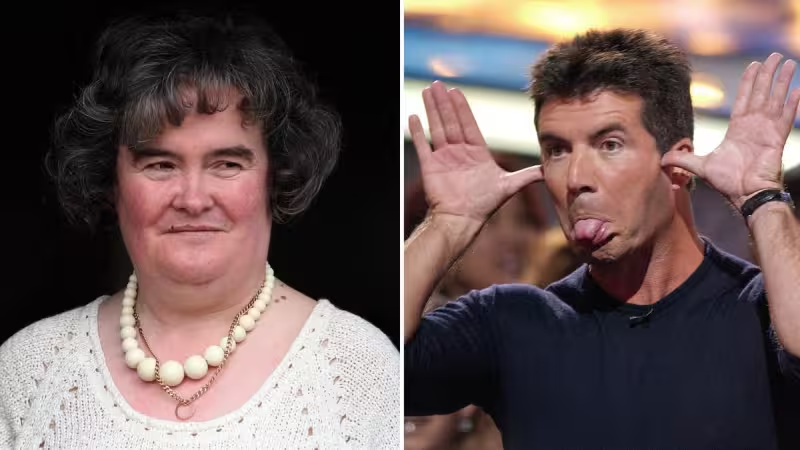
Simon Cowell says his treatment of Susan Boyle during her Britain's Got Talent audition was a wake-up call, nearly 10 years after the performance turned into one of the show’s defining moments. Speaking on a recent interview, Cowell reflected on how he and the panel misjudged Boyle when she stepped onto the stage in April 2009.
Cowell first met Boyle at the Clyde Auditorium in Glasgow, where she auditioned for the third series of Britain's Got Talent with a rendition of I Dreamed a Dream from Les Misérables. The performance brought a standing ovation, but Cowell, Amanda Holden and Piers Morgan initially reacted skeptically because of the way Boyle looked. Cowell later said he regretted how he behaved and recalled telling the audience, “We’re going to just tell it as it is,” before admitting, “You look awful.”
That audition became one of the best-known moments in Britain's Got Talent history, and it set up a series finale in which Boyle finished in second place behind Diversity. Cowell said the episode changed his outlook. “It was a bit of a wakeup call,” he said, adding, “You can’t judge a book by its cover.”

He said he ran up to Boyle after she lost and told her, “Susan, I’m going to sign you, just so you know, it doesn’t matter. It really, really doesn’t matter.” She later signed with his label, Syco Music, and released her debut album, I Dreamed a Dream, which sold over 10 million copies. Boyle went on to release eight more studio albums with the label, building a career that lasted long after the TV spotlight faded.
The reflection lands differently now because it revisits a moment that has already been absorbed into pop culture, while also underlining how harsh television can be when first impressions become the judgment. Boyle herself later told People magazine in 2019 that Cowell was the biggest inspiration in her career, saying he had been her boss for almost 10 years and that she still wanted to make him proud.
Cowell’s comments do not change what happened on that stage in Glasgow. They do show that he sees the Boyle audition not as a triumph of a panel’s instincts, but as proof that they got it wrong before the music even ended.