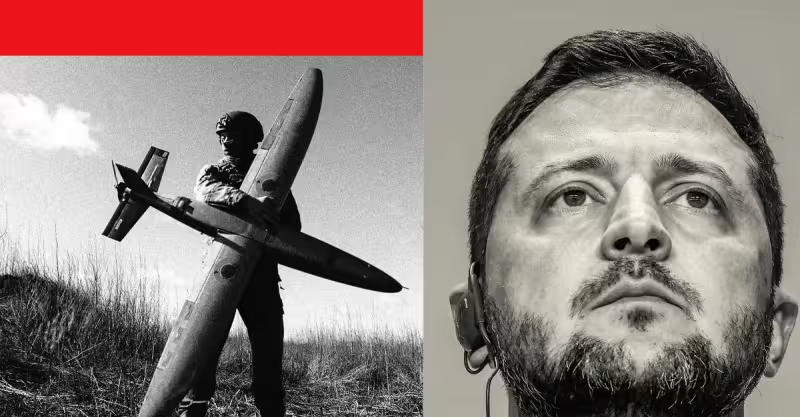
Ukraine is no longer pretending the United States can be counted on, with President Volodymyr Zelensky saying he now sees Washington as an unreliable ally after more than a year of trying to win Donald Trump over. The break came into sharper focus this week as Trump eased sanctions on Russian oil producers and sellers and Kyiv’s room to count on American weapons narrowed again.
Zelensky said in an interview with Italian radio last week that Russia had played Washington again, adding on X in English that “In my view, Russia played the Americans again—played the president of the United States.” That was not an offhand complaint. It was the clearest public sign yet that Ukraine is preparing for a future in which the United States may not come to its aid, even as Trump has largely halted American military assistance and recently reduced what little weaponry it was still selling to Kyiv to conserve supplies for the war against Iran.
The weight of that shift is visible in how Ukraine has spent the past several months. After Trump returned to the White House, Kyiv publicly tried for more than a year to bring him around. Trump instead repeatedly signaled sympathy for Vladimir Putin, personally berated Zelensky in the Oval Office in February 2025 and pushed peace talks that were tilted to reward Russia’s invasion and ended up fruitless. Zelensky agreed to mineral deals that were supposed to enrich Americans. None of it produced the security breakthrough Ukraine needed.



Instead, Kyiv has started building a network that reaches beyond Washington. Ukraine has been sharing its drone-warfare expertise with Saudi Arabia, Qatar and the United Arab Emirates, and it has been forging arms-production agreements with Germany. It has also sent drones to attack oil-export facilities near St. Petersburg, deep inside Russian territory, a reminder that Ukraine’s war effort is increasingly built around weapons and alliances it can control itself. For a fuller look at how drones have changed that fight, see the wider debate over Ukraine’s command-and-control model and the new battlefield logic it created.
The tension now is that Zelensky is saying out loud what many European leaders have spent the past 15 months trying not to say: the transatlantic relationship may not survive another Trump presidency in its old form. He said Europe needed to start moving on from it, and argued that if the United States is truly planning to withdraw from NATO, European democracies need a new security architecture. He said the European Union would need the capabilities of Norway, the United Kingdom, Turkey and Ukraine to defend itself from Russia without American help.
That is a harder break than the polite fiction NATO leaders have maintained. Secretary General Mark Rutte referred to Trump as “Daddy” during the past 15 months before later calling it a “language problem.” Trump, for his part, has lately not bothered with gestures such as harsh sanctions on Russia. Earlier this week, the sanctions waiver on Russian oil producers and sellers expired, but the broader message from Washington has been plain: pressure on Moscow is no longer the priority. Ukraine is acting accordingly.
The result is not just a diplomatic chill. It is a strategic reset in real time, with Kyiv moving to treat Europe and other partners as the place to build the military base it can no longer assume the United States will provide.