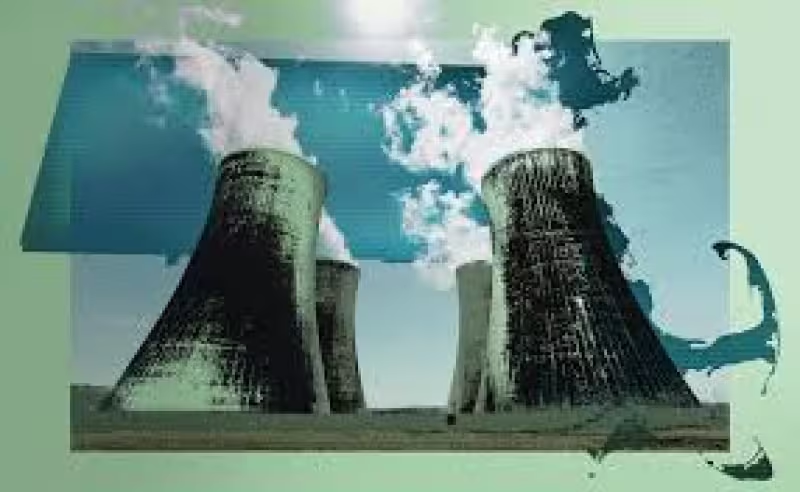
FORT PLYMOUTH, Mass. — Forty years after Chernobyl made nuclear power a political poison across much of New England, influential Massachusetts Democrats are moving to bring it back. Governor Maura Healey says it is time to build new reactors again, and all six New England governors have signed on to study new nuclear technologies.
The shift lands now because policymakers are trying to answer two problems at once: climate targets that are slipping and energy costs that keep climbing. Healey has said, in effect, that nuclear has to be part of the solution. For a region that effectively banned new reactor construction for decades after the Chernobyl disaster, that is a sharp break from the old playbook.
The numbers help explain why the debate has moved from theory to policy. Nuclear plants in New Hampshire and Connecticut already generate about a quarter of New England’s power supply, even as Massachusetts has lived without an operating reactor since Pilgrim Nuclear Power Station shut down in 2019. Pilgrim was once rated among the three least safe nuclear facilities in the United States, and the plant had spent years as a symbol of what anti-nuclear activists feared most.

That history is not abstract along the coast in Plymouth. Radioactive waste from Pilgrim sits in 20-foot concrete-and-steel casks on the Atlantic shore, about 5 miles from Plymouth Rock, while the company that owns the plant still seeks permission to dump more than 800,000 gallons of wastewater into Cape Cod Bay. For residents who fought Pilgrim for decades, the idea that the region is now being asked to look again at nuclear power feels like a reversal and a warning.
Deb Katz, who has spent years organizing against nuclear facilities, said her side has been trying to get people to see that the issue is not theoretical anymore. Diane Turco, standing near the Pilgrim casks on a recent afternoon, pointed toward the fence and said she could throw a baseball into the vent if she had a good arm. She also said she does not want to live near the plant.
That reaction carries the weight of history. Pilgrim was the last nuclear power plant built in New England, and the fight over Seabrook Station in New Hampshire in 1977, when more than 1,000 protesters were arrested, showed how deep the resistance ran. Chernobyl, still regarded as the worst nuclear meltdown in history, hardened that resistance for decades after Massachusetts effectively banned new reactors.
Now the politics have turned. The state that once treated nuclear expansion as a dead letter is again discussing reactors as part of its energy future. The question is no longer whether the region can imagine new nuclear power. It is whether lawmakers and voters are ready to accept it near the same coast where old fears were built, and where they still sit in concrete casks facing the sea.