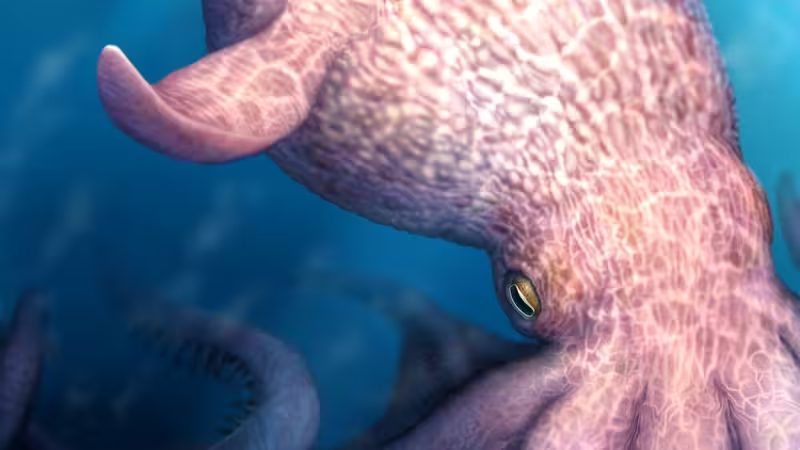
A giant octopus that lived between 100 million and 72 million years ago may have been one of the top hunters in prehistoric seas, a new study says. Researchers say Nanaimoteuthis haggarti stretched to about 60 feet long, making it larger than the biggest known giant squid by nearly 20 feet.
The study, published Thursday in Science, is based on 15 well-preserved beak fossils from Late Cretaceous deposits in Japan and on Vancouver Island. Using artificial intelligence-assisted software, the team found fossilized octopus beaks buried in Japanese sediment samples and recovered 12 additional fossilized octopus jaws, giving them enough material to connect the larger specimens to a pair of previously known species in the genus Nanaimoteuthis.



That matters because these large octopuses were long thought to be close relatives of vampire squids. They are now viewed as ancient relatives of finned octopuses called Cirrata, deep-sea cephalopods with ear-like fins on the tops of their heads and webbing between their arms. Yasuhiro Iba said the find challenges the common view of an age of vertebrates in marine ecosystems, a line that now looks less like a settled fact and more like a fading assumption.
The fossils are rare because soft-bodied octopuses leave little behind. Their beaks, made primarily of chitin, are among the few hard parts that can survive long enough to fossilize, and they can be used to estimate body size in living species. That is what made this discovery possible, and why the size estimate carries unusual weight: if correct, Nanaimoteuthis haggarti rivaled mosasaurs and may have met sharks, plesiosaurs and mosasaurs on something closer to equal terms than marine history usually allows.
The friction in the study is not that octopuses left no trace, but that the trace was hidden in plain sight. Conventional techniques had missed the jaws that the software found, and Iba said the approach uncovered fossil jaws that would have been nearly impossible to find and allowed the team to reconstruct them as detailed 3D digital fossils. That means the picture of Late Cretaceous oceans has shifted from a world ruled only by vertebrates to one in which a giant octopus could have been a predator large enough to change the balance. The question now is not whether the animal was extraordinary; it is how many more giants are still waiting in sediment samples already thought to be exhausted.