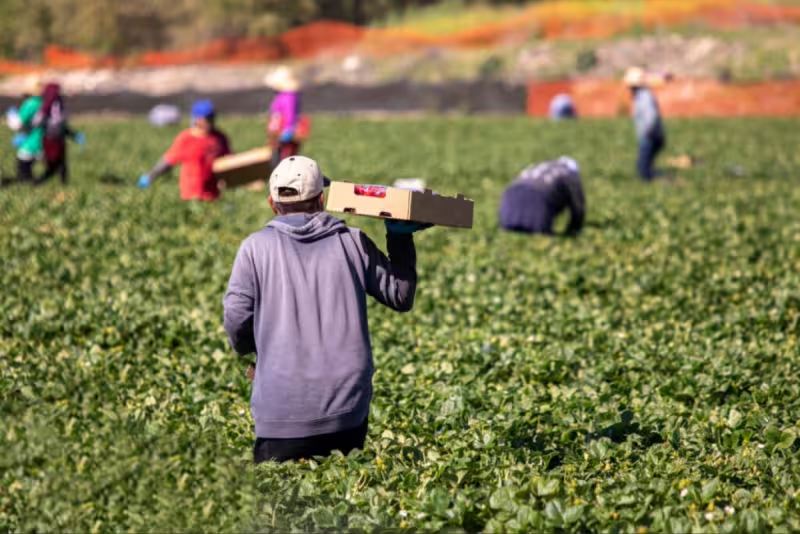
The U.S. Occupational Safety and Health Administration has dropped its numerical inspection targets from a revamped heat-hazard program and removed fruit and tree nut farming from the list of priority industries. The updated directive took effect April 10, 2026, and will stay in place until 2031.
OSHA said the revised National Emphasis Program “removes outdated background information, updates links, and eliminates the former numerical inspection goal.” The agency also narrowed its focus to 55 industries it considers high-risk, based on Bureau of Labor Statistics data from 2022 to 2025, while adding hog and pig farming, animal slaughtering and processing, and greenhouse, nursery and floriculture production.
The change matters now because it resets how the agency looks for heat danger during the parts of the year when workers face the greatest exposure. OSHA said compliance officers will still step up inspections when there is evidence of heat-related hazards on heat priority days, and they will do random inspections in high-risk industries when the National Weather Service issues a heat advisory or warning.

The shift is being presented as a sharpening of focus rather than a pullback, but it also removes a concrete target that once guided enforcement. OSHA had previously aimed to double on-site heat inspections compared with the 2017 to 2022 average, and it had conducted 7,000 heat-related inspections through December 2024. A report by E&E News said about 200 heat-related inspections were carried out per year in the five years before the original standard began in 2022.
Jocelyn Sherman said the timing leaves her uneasy, warning that “in this time of climate change and rising temperatures, it is terrifyingly unclear whether OSHA will still proactively inspect hot worksites.” The concern lands against a basic fact of the workplace: there is still no federal heat standard, and employer obligations continue to rest on OSHA’s General Duty Clause.
Several states with OSHA-approved plans already enforce their own heat-illness prevention rules, including California, Oregon, Washington, Colorado, Maryland, Minnesota and Nevada. That patchwork has made farm and outdoor labor especially sensitive to federal enforcement choices, because agricultural work has long been one of the highest-risk jobs for heat-related illness and death.
OSHA’s new list no longer names fruit and tree nut farming as a priority industry, even as it adds other agricultural and animal-processing sectors. The practical answer to the headline question is that the agency is not abandoning heat enforcement; it is changing who gets watched most closely, and how much the public can expect from the numbers that once measured that effort.