
Former Sen. Ben Sasse said in December 2025 that he has metastatic pancreatic cancer, a stage 4 diagnosis that had already spread to his liver and lungs. In a recent interview, the 54-year-old said he was first told he had only three to four months to live, but that a clinical trial drug has changed the trajectory of his illness.
Sasse told 60 Minutes that he has “much, much less pain” than he did four months earlier and that his tumor volume had fallen 76% over that span. The former Nebraska senator, who represented the state in the U.S. Senate from 2015 to 2023, said the reduction came after he entered a trial for daraxonrasib, an oral therapy designed to block the defective gene that drives uncontrolled cellular growth.
Revolution Medicines shared phase 3 data on daraxonrasib in people with metastatic pancreatic cancer who had not responded to standard chemotherapy. In those results, patients taking the drug lived a median of 13 months, compared with around six months for those who continued with chemotherapy, a difference that has pushed the treatment into the final stages of clinical trials.
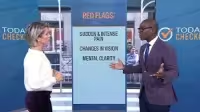

That matters because pancreatic cancer is often found late, when symptoms are absent or so subtle that the disease is already widespread. Marc Siegel said that makes the cancer unusually difficult to catch early, and he called daraxonrasib the first-of-its-kind targeted therapy for pancreatic cancer. Sarbajit Mukherjee said the medicine goes after a key growth switch in many cancers called RAS, which in pancreatic tumors is typically locked in the on position and keeps telling cells to grow and spread.
The gap between that scientific promise and the reality for most patients is still stark. The drug has shown the ability to double survival in people previously treated for metastatic pancreatic cancer, but it remains in the final stages of clinical testing rather than routine use, and Sasse’s response is not the same as a cure. Even so, his account is the clearest public example yet of what the therapy can do for a patient who was given months, not years, to live.
For Sasse, the answer to the question hanging over the story is plain enough: the trial did not erase the cancer, but it gave him time, relief and a result that even he did not expect to hear back from the scan.