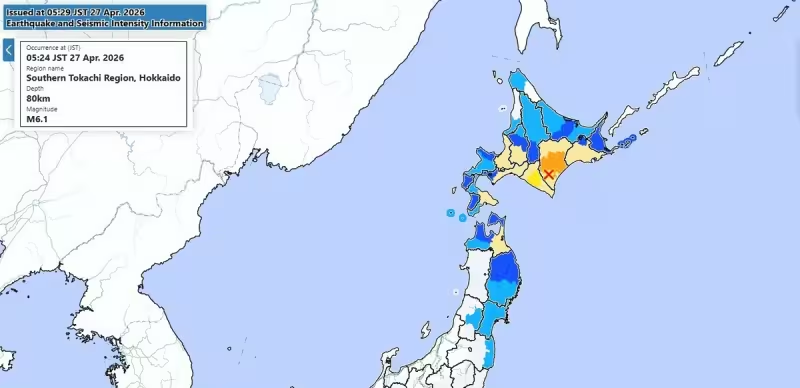
Japan’s meteorological agency ended a weeklong advisory on Monday that warned of a higher risk of a strong earthquake along the Pacific coast of northeastern Japan and Hokkaido, after a preliminary magnitude 6.2 quake jolted Hokkaido early in the morning. The agency said the two quakes were not directly related and said it would not issue a new advisory.
The latest quake struck the Tokachi region at 5:23 a.m. Monday and registered upper 5 on Japan’s seismic intensity scale of 7 in the town of Urahoro, with the focus at a depth of 83 kilometers. A woman in her 90s living in a facility in Hakodate was slightly injured when she fell, and the Hokkaido Shinkansen bullet train service was not disrupted.

The advisory, formally called the Off the Coast of Hokkaido and Sanriku Subsequent Earthquake Advisory, had covered seven prefectures from Hokkaido to Chiba after a magnitude 7.7 quake struck off northeastern Japan at 4:52 p.m. on April 20. That quake rattled Aomori Prefecture and its vicinity and sent tsunami waves as high as 80 centimeters to Kuji Port in Iwate Prefecture. The system is rooted in lessons from the M9.0 megaquake that devastated northeastern Japan on March 11, 2011, and the M7.3 temblor that followed.
The warning was only the second of its kind since December, and it asked people to be ready to evacuate immediately if they felt shaking or saw a tsunami warning, even as daily economic and social activity continued. The advisory came to a close with the country still counting the damage from the recent sequence: 10 injuries across Hokkaido, Aomori and Iwate prefectures and more than 100 schools temporarily closed.
Japan has said that a worst-case quake along the Japan and Chishima trenches could kill up to 199,000 people and send tsunami waves nearly 30 meters high in some areas, but that fatalities could be cut by 80 percent with better evacuation. Monday’s decision ends the weeklong alert, but it also leaves the country with the same stark calculation it has faced since 2011: lives are saved less by prediction than by how fast people move when the ground starts to shake.