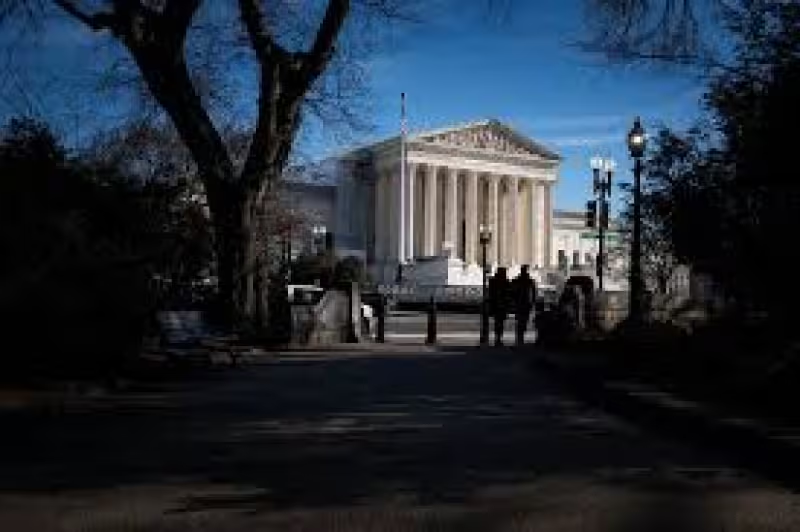
The Supreme Court ruled that Louisiana must redraw its congressional map, a decision that keeps alive a long-running fight over how far lawmakers can go in using race to make sure Black voters are fairly represented.
The case, Louisiana v. Callais, centered on a map drawn after the 2020 census by the Republican-controlled legislature. Under that plan, Black voters made up a majority in just one district even though they were about a third of the state’s population. A group of Black voters sued in 2022 under the Voting Rights Act, arguing that the map diluted Black voting power by packing Black voters into one district and spreading them across the rest. A federal judge agreed and ordered the state to draw a new map with a second majority-Black district.



Louisiana complied with a new map that created a second majority-Black congressional district stretching diagonally across the state from Shreveport to Baton Rouge. That map was then challenged by a group of non-Black voters, who said the state had sorted voters by race in violation of the 14th Amendment’s guarantee of equal protection. A three-judge panel agreed and blocked the map from taking effect last year, but the Supreme Court paused that ruling and the remedial map was used in the 2024 election, where Cleo Fields won the seat.
During oral arguments last March, the justices heard one round of the dispute and then asked lawyers to argue it again last fall, raising the question of whether section 2 of the Voting Rights Act is constitutional. Edward Greim, speaking for the plaintiffs challenging the map, told the court it was obvious that race had predominated in drawing the district because it was so irregularly shaped. Louisiana’s lawyers said the shape had a clear explanation: Republican leaders wanted to preserve the safe seats of Mike Johnson, Steve Scalise and Julia Letlow, and rejected the idea of drawing a more compact district if it meant putting those seats at risk.
The ruling leaves Louisiana with another redraw and extends a dispute that has already moved through years of legal wrangling over the state’s congressional lines. What the court’s decision now makes clear is that the state cannot keep the current map in place, and the next version will again have to balance Black voting strength, racial classifications and the safe seats that lawmakers were trying to protect.