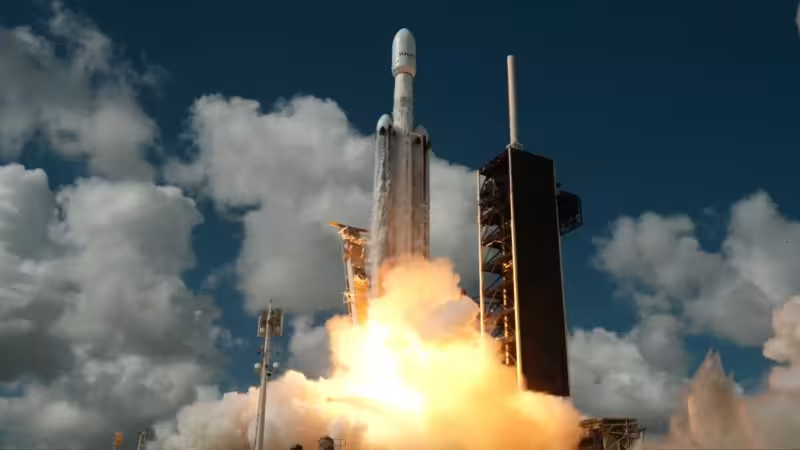
SpaceX will try again Wednesday to launch its Falcon Heavy rocket from NASA’s Kennedy Space Center after Monday’s attempt was scrubbed because of poor weather. Liftoff from Launch Complex 39A is scheduled for 10:13 a.m. EDT, with an 85-minute window, as the company aims to send ViaSat-3 F3 toward geosynchronous transfer orbit.
The 5.1 million pounds of thrust on tap for the mission will carry the six metric ton spacecraft on the 12th flight of a Falcon Heavy, a rocket that first debuted in 2018. The 45th Weather Squadron is forecasting a 90 percent chance of favorable weather during the window, with thick clouds the main concern, a better outlook than the 55 percent forecast tied to the earlier attempt.

The payload is the third and final satellite in the ViaSat-3 series, and it is central to a broader push in airborne connectivity that Viasat says will make free use of airborne WiFi and free streaming more common for airline passengers. Dave Abrahamian said the company expects customers to see more free WiFi and, with recent network updates, more free streaming as the spacecraft enters service. He said the public may simply notice that it is now possible to stream Netflix at 4K in the sky, even if they do not think about the technical steps behind it.
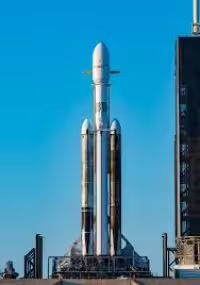
Falcon Heavy’s side boosters, tail numbers 1072 and 1075, will be flying for the second and 22nd time, respectively, and SpaceX plans to land them at LZ-2 and LZ-40 about 10 miles apart. The core stage, booster B1098, will not be recovered and will be discarded in the Atlantic Ocean. SpaceX is using the heavy-lift rocket because Abrahamian said it can place the satellite into a more favorable transfer orbit for electric propulsion, with the spacecraft expected to be dropped off just below geostationary Earth orbit apogee-wise, about 23,000 kilometers perigee-wise and about three degrees of inclination.
From there, Abrahamian said orbit raising to the operating position at 158.55 degrees East along the equator should take about two months, followed by at least a couple of months of deployment stages and checkouts before Boeing hands the vehicle over to Viasat. If Wednesday’s weather holds, SpaceX will not just be trying again after Monday’s scrub; it will be trying to put the last ViaSat-3 satellite into the orbit that gets it to work.