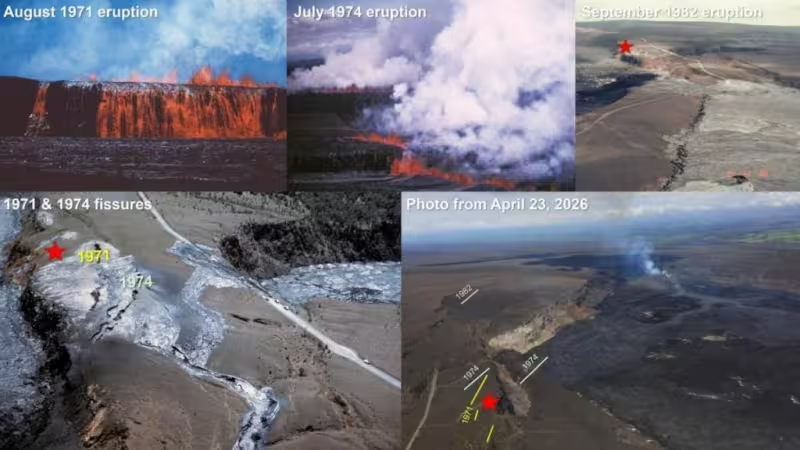
Halemaumau Crater has been Kīlauea’s usual summit outlet for decades, but a review of the volcano’s record shows its summit eruptions have not always stayed there. The ongoing fountaining episode that reached Episode 45 on April 23 comes amid a long history that includes eruptions outside the modern caldera, some close enough to the rim to reshape the summit landscape.
That matters because the summit is active again and the area around Kaluapele has a record that is broader than many visitors may realize. Since Dec. 23, 2024, lava fountaining has continued to generate flows that intermittently cover parts of the summit area, with the latest episode count underscoring how persistent the eruption has become.
For the past several decades, summit eruptions at Kīlauea have been confined to Halemaʻumaʻu, inside the larger steep-walled Kaluapele caldera at the volcano’s summit. That pattern was reinforced after 2008, when a decade-long lava lake formed inside Halemaʻumaʻu, then drained during the 2018 caldera collapse. A water lake replaced it for about a year and a half, before the December 2020 eruption destroyed that lake too.
But the historical record shows the summit has broken that pattern before. The earliest written documentation of summit eruptions outside the caldera dates to 1832 and 1868, both to the east of Kaluapele. In 1959, a lava-fountaining eruption at Kīlauea Iki formed Puʻupuaʻi, also east of the Kaluapele boundary.
Later summit activity pushed farther south. On Aug. 14, 1971, an eruption near Keanakākoʻi lasted about 10 hours and sent lava over the caldera rim before it solidified below Volcano House. In the July 19-22, 1974, eruption, lava flows cascaded over the rim, and one lobe dropped into the bottom of Keanakākoʻi Crater before continuing south and east until the eruption ended. The Sept. 25, 1982, eruption in the south caldera region lasted about 15 hours and sent a fissure system about a mile from the Keanakākoʻi overlook, with lava reaching within 700 yards of the overlook.
The 2018 collapse altered those landmarks, too. Portions of both the 1971 and 1974 fissures were lowered along with the caldera floor, changing how the summit floor sits today. The current lava-fountaining episodes, which began Dec. 23, 2024, now repeatedly send flows across this same area, though only intermittently.
Hawaiʻi Volcanoes National Park has interpretive signs near Keanakākoʻi that date to the era when Crater Rim Drive in the area was still open to motorists. The south caldera region referenced in the 1982 eruption is now part of the national park’s closed area because of the high volcanic hazard. The lesson from the record is clear: Halemaʻumaʻu remains the summit’s main vent, but it is not the only place Kīlauea can break through.