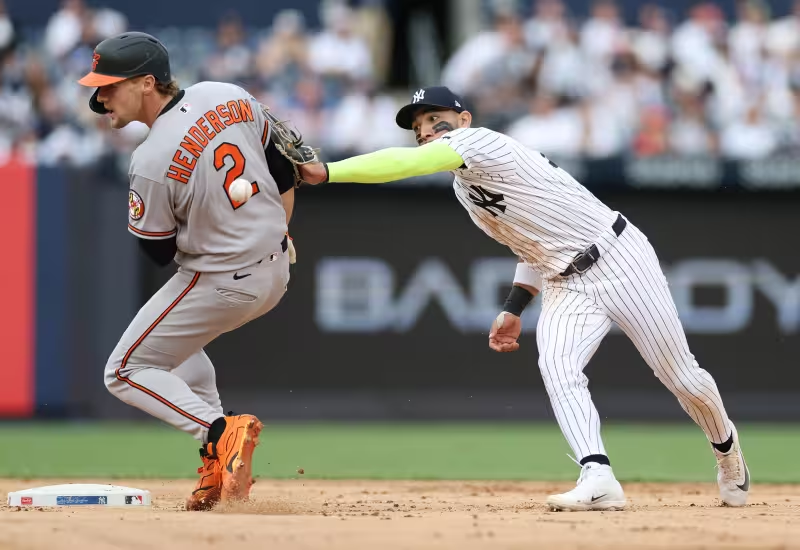
NEW YORK — The Orioles lost 9-4 to the Yankees on Saturday, and the damage came early again. Kyle Bradish allowed five runs in four innings, and Baltimore fell to three games below.500 at 15-18 with a three-game losing streak that has put its rotation back under a hard glare.
The problem is not one bad night. Orioles starters have given up five runs or more in four innings in each of the last three games, a run of short outings that has left the club searching for answers it did not fully buy in the offseason. Through 13 starts, Trevor Rogers and Bradish have combined for a 4.90 ERA.
That is the number that explains why this matters now. Baltimore did not sign a top-of-the-rotation arm this winter, and it did not add one last winter either, betting instead that internal options would grow into the kind of front-line starters that can steady a contender. Instead, the rotation has been thinned by injury and inconsistent performance, and the margin for error has disappeared fast.
Bradish’s start at Yankee Stadium pushed his ERA to 5.03, a long way from the form that earned him Cy Young votes in 2023. He returned late in 2025 from elbow surgery with real hopes that he could again look like the pitcher who once gave Baltimore a true ace profile. Instead, he said the staff’s expectations have not matched the results. “We talk about it, but it’s not just one thing that you can just wish would happen,” Bradish said. “I go out every outing and I think I’m going to go out and dominate every time, and that’s just not happening right now.” He added that it is “definitely not for a lack of effort with the whole starting staff.”

The frustration is not limited to the mound. Craig Albernaz said he is “not concerned,” but his tone made clear how far the club believes it has drifted from where it should be. He called the situation “more frustrating” because “that group is really talented,” and said, “I feel like we should not be three games below.500.” He took responsibility for that slide, saying, “That’s on me,” and adding that he needs “to do a better job leading these guys and getting the most out of them.”
There is a reason that admission lands so heavily. Dean Kremer was optioned to Triple-A to begin the season because the rotation looked deep enough in spring training to absorb it, but that depth has not held. Rogers is on the 15-day injured list for the flu, and the two starters expected to carry more of the load have not been close to enough. The Orioles had hoped that their internal arms could bridge the gap after missing on top-end free agents, yet the results have left them with a staff that has not stabilized even after repeated chances.
The tension is in what happened across the rest of the division’s conversations about pitching and what has not happened in Baltimore. Less than a week before this game, Chris Bassitt said the rotation had a “come-to-Jesus” talk, and Shane Baz said the pitchers had “a little talk about what we wanted to do going forward,” adding that it was “very productive.” Baz and Bassitt pitched well after that meeting. The Orioles have not had that kind of reset show up on the scoreboard yet, and Saturday’s loss made the gap between hope and performance even harder to ignore.
For Baltimore, the next step is not complicated, even if the answer is still missing: the rotation has to stop bleeding runs before the standings get away from it. Right now, the Orioles are not just losing games. They are losing the idea that their starting pitching can carry them when the rest of the roster needs it most.