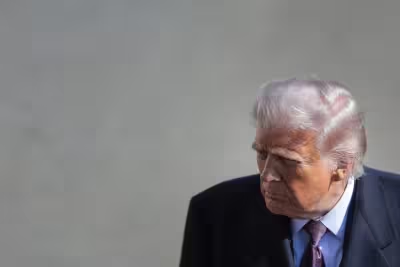
Viktor Orban conceded defeat on April 13, ending 16 years in power as Peter Magyar and the opposition Tisza party won an overwhelming victory in Hungary’s parliamentary election. The result gives Tisza more than two-thirds of the seats, a sweep that can reshape both Hungarian politics and Moscow’s footing in Europe.
The Kremlin moved quickly to make clear it would not hail the change. Spokesperson Dmitry Peskov said Russia would not congratulate Magyar because Hungary remains an “unfriendly country” that supports sanctions against Russia, and added that relations between Russia and the European Union cannot worsen after Hungary’s election because they are already at rock bottom. Foreign Minister Sergei Lavrov later said Russia was ready to build a relationship with the new Hungarian government, depending on how it understood its own national interests.
That caution matters because Orban had been Moscow’s most dependable voice inside the European Union. He consistently opposed and undermined EU military and financial assistance to Ukraine, and President Vladimir Putin personally backed him in the 2026 Hungarian parliamentary election. For Russia, the loss is not just symbolic. It removes a leader who repeatedly helped blunt European pressure at a moment when the Kremlin is still trying to keep its war economy supplied and its political cover in Europe intact.
Russian milbloggers reacted to Orban’s defeat with mixed feelings, including concern that the Kremlin has lost its main ally in the EU. Their anxiety lands alongside another warning sign for Moscow: economist Janis Kluge of the German Institute for International and Security Affairs said on April 12 that Russian forces recruited between 800 and 1,000 soldiers a day in the first quarter of 2026, down from 1,000 to 1,200 a day in the same period a year earlier, a 20 percent decrease. He said average signing bonuses hit a record 1.47 million rubles, or roughly $19,300, in March 2026, while Russian authorities had paid compensation to the families of around 25,000 killed Russian soldiers.
Put together, the messages point in the same direction. Hungary has slipped out of Moscow’s camp, and Russia is having to pay more to recruit fewer soldiers while absorbing heavier losses. The Kremlin can still try to work with Magyar, but the era in which Orban served as its anchor in the EU is over.