
Wall Street slipped Monday as oil surged and traders weighed the latest escalation between the United States and Iran, with the Dow Jones Industrial Average down 115 points, or 0.2%, at 11 a.m. Eastern time. The S&P 500 was off 0.4% from its all-time high, and the Nasdaq composite fell 0.7%.
Brent crude climbed 5.1% to $94.98 a barrel after the United States seized an Iranian-flagged cargo vessel that it said had tried to evade its blockade of Iranian ports. The move came after Iran reopened the Strait of Hormuz to commercial traffic on Friday, then closed it again on Saturday after Washington decided to press ahead with the blockade.
The market reaction was broad but uneven. Norwegian Cruise Line Holdings dropped 5.1%, Carnival lost 1.4%, United Airlines slipped 2.4% and American Airlines fell 5% after American said it was not interested in a merger with United. The jump in oil hit companies with large fuel bills, a group that has been among the harder-hit corners of Wall Street during the war.

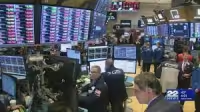
The pullback came after a record-breaking rally for stocks, and the S&P 500 was still above where it stood before the war. Oil had already surged to more than $119 a barrel when fears were at their highest, before easing as the ceasefire and shipping tensions shifted. A ceasefire agreement between the United States and Iran was scheduled to expire Tuesday night at 8 p.m. Eastern time, or early Wednesday in Tehran.
Not every company tied to the market’s fear trade was lower. TopBuild jumped 16.4% after QXO agreed to buy it in a deal valued at roughly $17 billion, a transaction QXO said would make it the continent’s second-largest publicly traded building products distributor. QXO’s stock fell 8.2% after announcing the deal.
Still, the larger market tone remained cautious. Recent bank earnings had helped keep U.S. stocks strong, with lenders saying the economy remained resilient, and Morgan Stanley strategists led by Michael Wilson said the earnings recovery remains intact despite the geopolitical risks. That view has helped explain why shares were able to recover so quickly after earlier swings, including a 868-point Dow Jones Industrial Average jump during last week’s surge and a fresh-record rally when ceasefire hopes briefly lifted Wall Street.
The next test is the deadline itself. If the ceasefire expires without a new arrangement, traders will be forced to decide whether oil at under $95 a barrel is a pause or just the latest stop in a much larger shock.