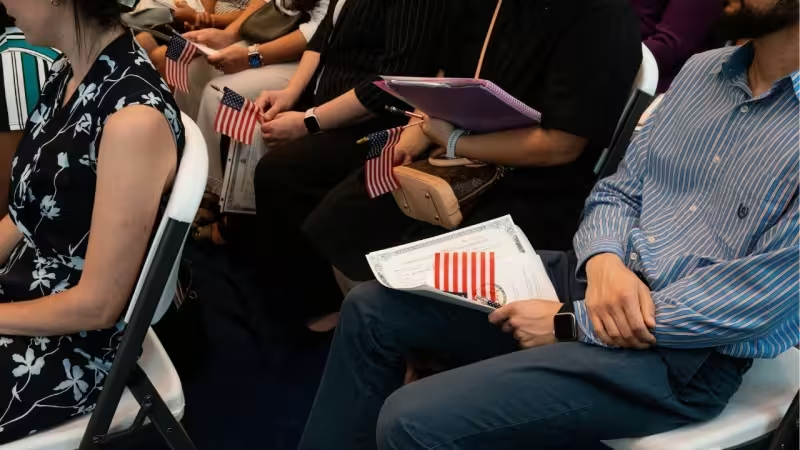
The Justice Department has identified 384 foreign-born Americans whose citizenship it wants to revoke, and senior officials told colleagues last week that civil litigators in 39 regional U.S. attorney’s offices would soon be assigned denaturalization cases.
The move would push denaturalization faster, with the department saying it wants to increase the pace of those cases. Traditionally, the work has been handled by specialists in the Justice Department’s Office of Immigration Litigation, not spread across dozens of regional offices. In recent years, the numbers have stayed relatively small: from 2017 to late last year, the government sought to strip just over 120 naturalized Americans of their citizenship. Between 1990 and 2017, it filed 305 denaturalization cases, an average of 11 a year.
Federal law lets the government ask a court to revoke citizenship if it was obtained fraudulently, including through a sham marriage or by withholding information about a past that would have made someone ineligible. Some people who commit crimes can also be denaturalized, but the government must prove its case to a federal judge in a civil or criminal proceeding.

The new push reflects a broader immigration crackdown. Recently, Trump administration officials ordered Department of Homeland Security staffers to refer upward of 200 denaturalization cases a month to the Justice Department, and the department said it is now pursuing the highest volume of denaturalization referrals in history from Homeland Security. That would mark a sharp change from the recent past, when denaturalization remained rare and largely confined to a small group of specialists.
Matthew Tragesser, speaking for the department, said officials are pursuing the highest volume of denaturalization referrals in history and are “laser focused on rooting out criminal aliens defrauding the naturalization process.” Abigail Jackson, a spokeswoman for the administration, said citizenship fraud is a serious crime and that anyone who obtained citizenship through fraud and deceit will be held accountable.
Not everyone sees a routine enforcement step. Amanda Frost, a law professor who has studied the issue, said the message is that naturalized citizens do not have the same rights and stability as native-born citizens. She also said the government has used this power in the past to target people it views as political opponents. That warning lands with more force now because the cases are no longer being kept inside one specialized office and because the number of referrals is rising so quickly.
The Justice Department’s answer is straightforward: it says it is targeting fraud, not citizenship itself. The next test will be whether the courts accept that broadening the machinery of denaturalization still stays within the narrow legal limits Congress and the Constitution allow.