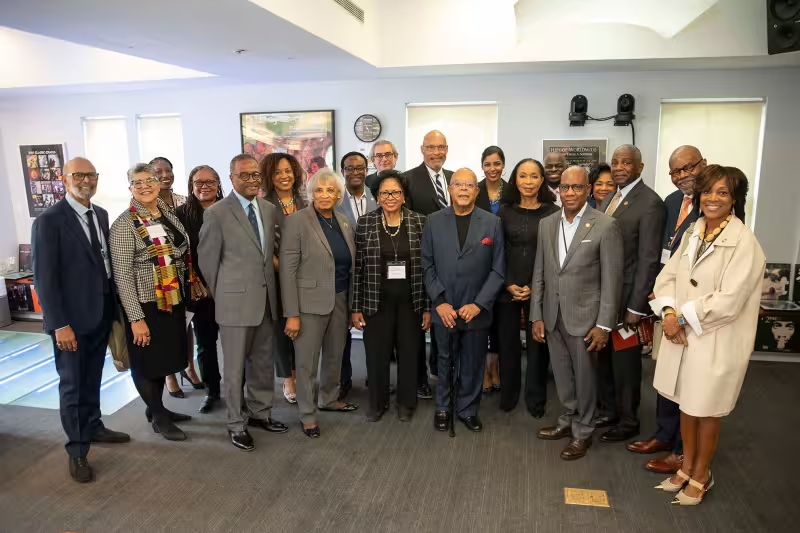
Harvard is giving a three-year, $1.05 million grant to a new coalition of 15 historically Black colleges and universities that are trying to build research power and move closer to R1 status. The money will go to the Association of Historically Black Colleges and Universities Research Institutions, a group known as AHRI, through Harvard’s Harvard & the Legacy of Slavery Initiative.
The grant is meant to support research infrastructure and technical assistance at the 15 schools, while Harvard’s Office of the Vice Provost for Research and Office for Sponsored Programs help with research administration and compliance. Sara Naomi Bleich said the initiative is deepening its commitment to enduring partnerships with HBCUs, and Harvard said the new funding strengthens that commitment at HBCUs.
The timing matters because Harvard said the grant directly carries out Recommendation Three from the university’s 2022 Report of the Presidential Committee on Harvard & the Legacy of Slavery, which called for lasting connections with HBCUs. The initiative took shape after HBCU presidents and leaders gathered at Harvard’s Hutchins Center for African & African American Research in September 2023, and in 2024 Ruth Simmons and Bleich began discussing how Harvard could help advance research capacity at HBCUs.
AHRI is a new coalition built to help member schools strengthen research, innovation and impact, with an eye on the Carnegie Classification of Institutions of Higher Education. Tomikia P. LeGrande said the 15 universities in the coalition collectively account for 50 percent of all competitively awarded federal research funding among HBCUs, spanning both R2 and R1 designations. Howard University is the first HBCU to earn R1 status and is now the only AHRI partner institution with that designation.
That imbalance is part of what gives the grant its weight. LeGrande called AHRI an important inflection point for HBCU research institutions, while Simmons said it marks a new chapter in the HBCU research landscape. Harvard’s backing is modest compared with the scale of the challenge, but it gives the coalition a named partner with research infrastructure expertise and a clear mandate to help strengthen systems that many schools have had to build without comparable resources.
What happens next is whether that support translates into stronger grant administration, better compliance systems and more competitive research programs across the 15 schools. If it does, AHRI could become a model for how major research universities work with HBCUs not as isolated recipients of aid, but as institutions building toward the highest level of research recognition on their own terms.