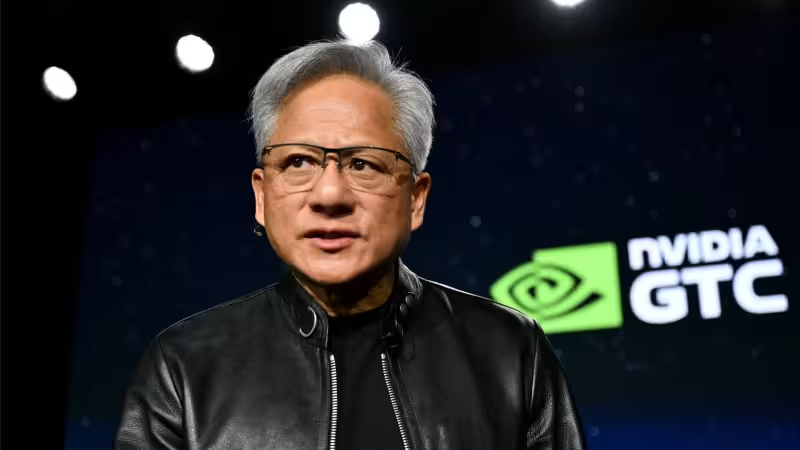
Jensen Huang said the United States would make a costly mistake if it tried to wall off China from Nvidia’s chips, arguing in a recent podcast that cutting off sales would not stop Chinese AI progress. On April 16, a tweet shared the exchange with Dwarkesh Patel, who pressed Huang on whether giving Chinese access to AI chips threatens American companies and national security.
Huang answered that it would be “extremely foolish” to create two ecosystems, one open-source system running on a foreign tech stack and another closed system running on the American tech stack. He said that would be “a horrible outcome for the United States,” and added that the goal should be to keep AI developers around the world building on the American tech stack so open-source advances flow back into the U.S. ecosystem.



The debate turned on scale. Patel cited Anthropic’s Claude Mythos, saying it exposed thousands of zero-day vulnerabilities across every major operating system and every major web browser. Huang replied that Mythos had been trained on fairly mundane capacity and a fairly mundane amount of it, and said China already has access to a lot of compute power. Nvidia, he said, still makes the most advanced and most efficient chips.
That matters because the argument over chip exports has become part of a broader U.S. policy fight over whether restricting sales would actually slow Chinese AI development. Huang said China can still reach advanced models through brute force, pointing to Huawei’s AI CloudMatrix cluster, and said keeping Nvidia out of China would not stop Chinese labs from building frontier systems. If chip sales are blocked, he said, Chinese AI will simply be trained outside the American tech stack.
Huang also pushed back on the idea that Nvidia would lose China regardless. “We have to keep innovating and, as you probably know, our share is growing, not decreasing,” he said, adding that the premise that Nvidia would lose the China market anyway is not correct. His view is blunt: the U.S. should compete by keeping the world’s AI builders tied to American infrastructure, not by forcing them to build elsewhere.